


Pigment Biosynthesis in Plants
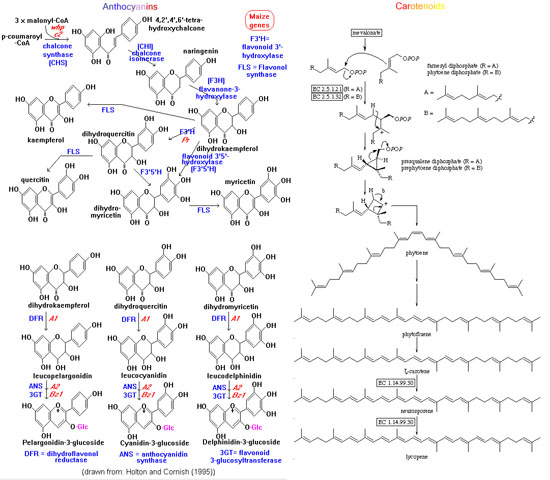
Shows the biosynthetic pathways that lead to the synthesis of carotenoids and anthocyanins in plants.
biochemical reactions leading to the synthesis of complex molecules are organized in multi-step pathways that underlay metabolic control and the regulation of gene expression pigment biosynthesis,regulation of gene expression,biosynthetic pathways,metabolic control,anthocyanins,biochemical reactions,gene regulation,carotenoids,molecules,synthesis,plants
- ID: 16096
- Source: DNALC.DNAi
Related Content

16687. Concept 33: Genes can be turned on and off.
Organisms can regulate gene expression.

2065. RNA-binding proteins
Professor James Eberwine describes the primary functions of RNA-binding proteins, which include regulating tRNAs, degrading RNAs, synthesizing RNAs, and regulating multigenic gene expression.

1466. TPH2 Gene
Because serotonin is critical to so many processes in the central nervous system, genes involved in its synthesis are interesting to neuroscientists.

16360. Animation 16: One gene makes one protein.
George Beadle and Edward Tatum present their experiments with Neurospora bread mold.

15276. Genes control the structure of proteins, François Jacob
François Jacob talks about Genes control the structure of proteins


1361. Model Organisms (Lesson)
Students work through a series of experiments that investigate the use of model organisms in the search for a better understanding of the genes that influence memory formation.

15684. Jacob's lac operon drawing
Small image of François Jacob's lac operon drawing.

16688. Animation 33: Genes can be turned on and off.
Jacques Monod and François Jacob work with how bacteria breaks large sugars into smaller pieces.

550. The Neural Code
Cognitive information is encoded in patterns of nervous activity and decoded by molecular listening devices at the synapse. Professor Seth Grant explains how different patterns of neural firing are critical to cognition.