


Sex cells have one set of chromosomes; body cells have two.
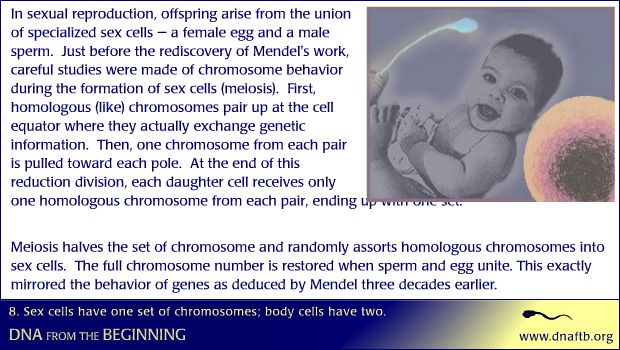
Offspring arise from the union of specialized sex cells — a female egg and a male sperm.
In sexual reproduction, offspring arise from the union of specialized sex cells — a female egg and a male sperm. Just before the rediscovery of Mendel's work, careful studies were made of chromosome behavior during the formation of sex cells (meiosis). First, homologous (like) chromosomes pair up at the cell equator where they actually exchange genetic information. Then, one chromosome from each pair is pulled toward each pole. At the end of this reduction division, each daughter cell receives only one homologous chromosome from each pair, ending up with one set. Meiosis halves the set of chromosome and randomly assorts homologous chromosomes into sex cells. The full chromosome number is restored when sperm and egg unite. This exactly mirrored the behavior of genes as deduced by Mendel three decades earlier.
chromosome behavior, cell equator, sex cells, chromosome number,female egg, male sperm, sexual reproduction, genetic information, set of chromosomes, offspring, genes, meiosis,reduction division, homologous chromosomes, daughter cell
- ID: 16237
- Source: DNALC.DNAFTB
Related Content

16249. Specialized chromosomes determine sex.
DNAFTB Concept 9: Study of meiosis revealed the chromosomal basis of sex.

16238. Sex cells have one set of chromosomes; body cells have two.
DNAFTB Animation 8: Theodor Boveri presents chromosomes' role in development.

16250. Specialized chromosomes determine sex.
DNAFTB Animation 9: Nettie Stevens and Edmund Wilson explain how biological sex is determined by special chromosomes.

16248. Sex cells have one set of chromosomes; body cells have two.
DNAFTB Problem 8: Take a look at human chromosomes.

16228. Concept 7: All cells arise from pre-existing cells.
An overview of the discovery of cell division, mitosis.

16236. All cells arise from pre-existing cells.
DNAFTB Problem 7:Look at the chromosome number of fruit flies.

16246. Biography 8: Theodor Boveri (1862-1915)
Theodor Boveri described the process of meiosis. He also showed that although chromosomes may look similar, they have specific hereditary qualities.

10536. "Fig. 6. The chromosomes of man"
"Fig. 6. The chromosomes of man"

16996. Genes and Inheritance
An animation introducing the basic concepts of genetics and recessive inheritance.

16931. 2D Animation of Genes and Inheritance
An animation introduces DNA and the pattern of inheritance for SMA.