


Chromosomes carry genes.
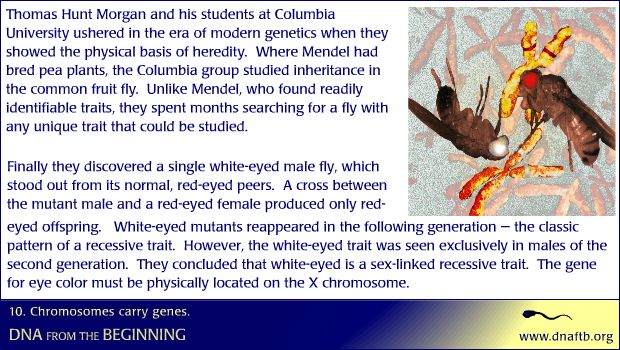
Fruit flies help to reveal that chromosomes carry genes.
Thomas Hunt Morgan and his students at Columbia University ushered in the era of modern genetics when they showed the physical basis of heredity. Where Mendel had bred pea plants, the Columbia group studied inheritance in the common fruit fly. Unlike Mendel, who found readily identifiable traits, they spent months searching for a fly with any unique trait that could be studied. Finally they discovered a single white-eyed male fly, which stood out from its normal, red-eyed peers. A cross between the mutant male and a red-eyed female produced only red-eyed offspring. White-eyed mutants reappeared in the following generation — the classic pattern of a recessive trait. However, the white-eyed trait was seen exclusively in males of the second generation. They concluded that white-eyed is a sex-linked recessive trait. The gene for eye color must be physically located on the X chromosome.
thomas hunt morgan, columbia university, x chromosome, fruit fly, sex-linked recessive trait,heredity, inheritance, modern genetics, white-eyed male fruit fly, red-eyed fruit fly,
- ID: 16262
- Source: DNALC.DNAFTB
Related Content

16263. Chromosomes carry genes.
DNAFTB Animation 10:Thomas Hunt Morgan describes his discoveries using fruit flies.

16278. Chromosomes carry genes.
DNAFTB Problem 10: Perform some fruit fly crosses.

1719. Fruit fly (Drosophila melanogaster)
The fruit fly is easy to maintain, has large numbers of offspring, and grows quickly. The fruit fly shares with humans a number of so-called “master,” or homeotic, genes.

16269. Gallery 10: Columbia University Fly Room, around 1920
The Fly Room at Columbia University, around 1920.

16280. Genes get shuffled when chromosomes exchange pieces.
DNAFTB Animation 11: Alfred Sturtevant describes gene mapping.

16264. Gallery 10: Male Fruit Fly
Early drawing of a male fruit fly.

16277. Biography 10: Thomas Hunt Morgan (1866-1945)
Thomas Hunt Morgan was one of the first true geneticists.

16299. Genes get shuffled when chromosomes exchange pieces.
DNAFTB Problem 11: Determine gene linkage in fruit flies.

16314. Concept 13: Mendelian laws apply to human beings.
Family pedigrees provided evidence of Mendelian inheritance in humans.

16588. Animation 27: Mutations are changes in genetic information.
Herman Muller induces fruit fly mutations. Seymour Benzer works with virus mutants ans proved only one nucleotide change can cause mutation.