


Concept 16: One gene makes one protein.
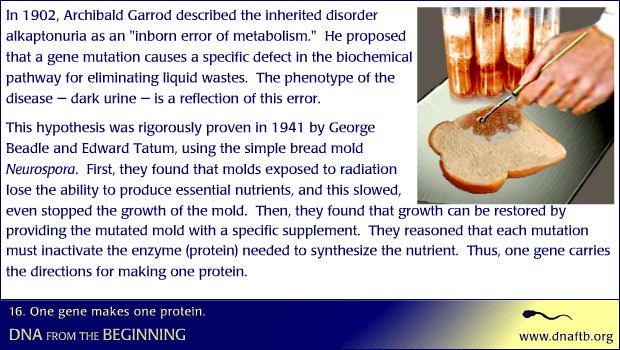
Beadle and Tatum learn that mutations inactivate proteins.
In 1902, Archibald Garrod described the inherited disorder alkaptonuria as an "inborn error of metabolism." He proposed that a gene mutation causes a specific defect in the biochemical pathway for eliminating liquid wastes. The phenotype of the disease — dark urine — is a reflection of this error. This hypothesis was rigorously proven in 1941 by George Beadle and Edward Tatum, using the simple bread mold Neurospora. First, they found that molds exposed to radiation lose the ability to produce essential nutrients, and this slowed, even stopped the growth of the mold. Then, they found that growth can be restored by providing the mutated mold with a specific supplement. They reasoned that each mutation must inactivate the enzyme (protein) needed to synthesize the nutrient. Thus, one gene carries the directions for making one protein.
george beadle and edward tatum, archibald garrod, inborn error of metabolism, bread mold, enzyme protein, gene mutation, biochemical pathway, alkaptonuria, dark urine, mutations, hypothesis, reflection, radiation
- ID: 16359
- Source: DNALC.DNAFTB
Related Content

16360. Animation 16: One gene makes one protein.
George Beadle and Edward Tatum present their experiments with Neurospora bread mold.

16322. Biography 13: Sir Archibald Edward Garrod (1857-1936)
Archibald Garrod was the first to connect a human disorder with Mendel's laws of inheritance.

15398. Chromosome 3: gene associated with alkaptonuria, Matt Ridley
Matt Ridley talks about chromosome 3, gene associated with alkaptonuria.

16371. Biography 16: George Wells Beadle (1903-1989)
George Beadle had successful research careers in corn and Drosophila genetics, before starting the field of Neurospora research.

16323. Problem 13: Mendelian laws apply to human beings.
Trace alkaptonuria through a family pedigree.

15931. What is Alkaptonuria?
Mutations in the HGD gene can cause the rare disorder alkaptonuria.

16316. Gallery 13: Sir Archibald Edward Garrod, ca 1910
Sir Archibald Edward Garrod, around 1910

16367. Gallery 16: Telegram sent to Edward Tatum telling him that he, George Beadle and Joshua Lederberg will share the 1958 Nobel Pri
Telegram sent to Edward Tatum telling him that he, George Beadle and Joshua Lederberg will share the 1958 Nobel Prize in Physiology or Medicine.

16372. Biography 16: Edward Lawrie Tatum (1909-1975)
Edward Tatum and George Beadle used Neurospora to prove that "one gene makes one protein." Tatum also had a role in starting bacterial genetics.

16317. Gallery 13: Colonel Archibald Edward Garrod
Colonel Archibald Edward Garrod in his World War I uniform.