


Concept 20: A half DNA ladder is a template for copying the whole.
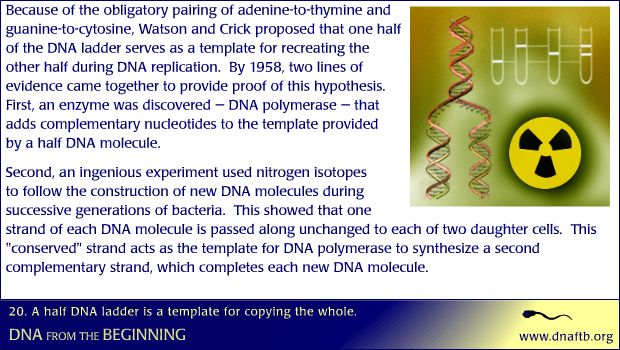
DNA polymerase and an experiment using nitrogen isotopes prove DNA replication.
Because of the obligatory pairing of adenine-to-thymine and guanine-to-cytosine, Watson and Crick proposed that one half of the DNA ladder serves as a template for recreating the other half during DNA replication. By 1958, two lines of evidence came together to provide proof of this hypothesis. First, an enzyme was discovered — DNA polymerase — that adds complementary nucleotides to the template provided by a half DNA molecule. Second, an ingenious experiment used nitrogen isotopes to follow the construction of new DNA molecules during successive generations of bacteria. This showed that one strand of each DNA molecule is passed along unchanged to each of two daughter cells. This "conserved" strand acts as the template for DNA polymerase to synthesize a second complementary strand, which completes each new DNA molecule.
dna polymerase, dna ladder, dna molecule, watson and crick, dna replication, dna molecules, complementary strand, ingenious experiment, daughter cells, cytosine, adenine, nucleotides, nitrogen, hypothesis, bacteria, generations, acts
- ID: 16442
- Source: DNALC.DNAFTB
Related Content

16443. Animation 20: A half DNA ladder is a template for copying the whole
Matthew Meselson and Franklin Stahl show how new DNA is made by copying the old.

16421. Concept 19: The DNA molecule is shaped like a twisted ladder.
Deoxyribose and phosphate molecules form the uprights and nucleotide pair form the rungs of the DNA ladder.

1445. DNA
Because it contains the directions for assembling the components of the cell, DNA is often thought of as the "instruction book" for assembling life.

16422. Animation 19: The DNA molecule is shaped like a twisted ladder.
James Watson and Francis Crick explain how they solved the structure of DNA. Erwin Chargaff explain how he measured the levels of each of the four nitrogenous bases.

15530. DNA replication: how genetic information is passed on, 3D animation with narration
The structure of DNA, that Watson and Crick discovered, suggests how genetic information is passed on.

16022. James Watson and Francis Crick, 1953
The DNA molecule is shaped like a twisted ladder.

15678. Watson and Crick's 1953 Nature paper
James Watson and Francis Crick's 1953 Nature paper.

15677. DNA helix model closeup
Image of DNA helix model (closeup).

16515. Animation 23: A gene is a discrete sequence of DNA nucleotides.
Fred Sanger outlines DNA sequencing.

15492. Discovering the double helix structure of DNA, James Watson, video with 3D animation and narration
James Watson used cardboard cutouts representing the shapes of the DNA bases to figure out how bases pair.