


Concept 21: RNA is an intermediary between DNA and protein.
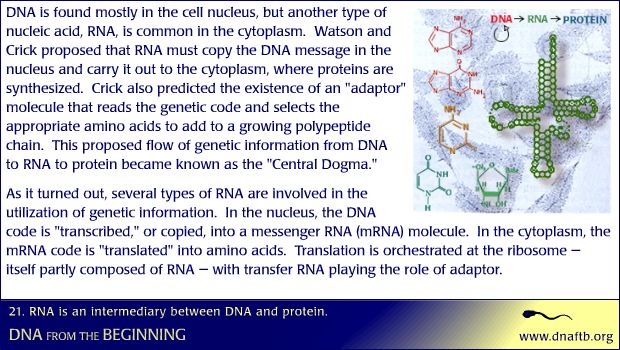
The Central Dogma is the flow of genetic information from DNA, to RNA, to protein.
DNA is found mostly in the cell nucleus, but another type of nucleic acid, RNA, is common in the cytoplasm. Watson and Crick proposed that RNA must copy the DNA message in the nucleus and carry it out to the cytoplasm, where proteins are synthesized. Crick also predicted the existence of an "adaptor" molecule that reads the genetic code and selects the appropriate amino acids to add to a growing polypeptide chain. This proposed flow of genetic information from DNA to RNA to protein became known as the "Central Dogma." As it turned out, several types of RNA are involved in the utilization of genetic information. In the nucleus, the DNA code is "transcribed," or copied, into a messenger RNA (mRNA) molecule. In the cytoplasm, the mRNA code is "translated" into amino acids. Translation is orchestrated at the ribosome —itself partly composed of RNA — with transfer RNA playing the role of adaptor.
mrna molecule, watson and crick, central dogma, polypeptide chain, transfer rna, messenger rna, cell nucleus, dna code, types of rna, amino acids, genetic information, cytoplasm, ribosome, nucleic acid, proteins, protein, translation
- ID: 16470
- Source: DNALC.DNAFTB
Related Content

16471. Animation 21: RNA is an intermediary between DNA and protein.
Francis Crick describes RNA and its role and Paul Zamecnick explains protein synthesis.

15481. Translation: RNA to protein, 3D animation with no audio
Translation: RNA to protein, 3D animation with no audio

15501. Translation: RNA to protein, 3D animation with basic narration
3D animation of translation: RNA to protein.

1023. Pathways, Making the protein
In this section learn that in the cytoplasm, the messenger RNA is released from its carrier proteins and binds to a protein assembly complex called a ribosome.

16933. 3D Animation of DNA to RNA to Protein
An animation shows how the DNA genetic "code" is made into protein.

16492. Problem 21: RNA is an intermediary between DNA and protein.
What happens in protein synthesis?

16494. Animation 22: DNA words are three letters long.
Several researchers crack the genetic code.

15473. The Central Dogma: transcription and translation, James Watson
James Watson talks about the Central Dogma: transcription and translation.

15679. Translation, small still image
Small image depicting translation.

16932. Flow of Information from DNA to RNA to Protein
Dr. Roberts describes the flow of information from DNA to RNA to protein.