


Concept 37: Master genes control basic body plans.
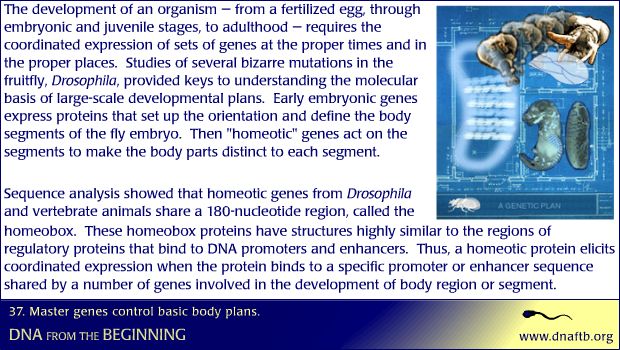
Fruit fly mutaitons provided keys to understanding the molecular basis of large-scale developmental plans.
The development of an organism — from a fertilized egg, through embryonic and juvenile stages, to adulthood — requires the coordinated expression of sets of genes at the proper times and in the proper places. Studies of several bizarre mutations in the fruitfly, Drosophila, provided keys to understanding the molecular basis of large-scale developmental plans. Early embryonic genes express proteins that set up the orientation and define the body segments of the fly embryo. Then "homeotic" genes act on the segments to make the body parts distinct to each segment. Sequence analysis showed that homeotic genes from Drosophila and vertebrate animals share a 180-nucleotide region, called the homeobox. These homeobox proteins have structures highly similar to the regions of regulatory proteins that bind to DNA promoters and enhancers. Thus, a homeotic protein elicits coordinated expression when the protein binds to a specific promoter or enhancer sequence shared by a number of genes involved in the development of body region or segment.
bizarre mutations, homeotic genes, body segments, regulatory proteins, juvenile stages, vertebrate animals, fruitfly, molecular basis, nucleotide, adulthood, body parts, promoters, promoter, organism, embryo, segment, dna
- ID: 16759
- Source: DNALC.DNAFTB
Related Content

16760. Animation 37: Master genes control basic body plans.
Eric Wieschaus and Christiane Nüsslein-Volhard explain research of Drosophila's developmental stages, and Ed Lewis presents homeotic mutations.

16782. Problem 37: Master genes control basic body plans.
Explore Drosophila development and embryonic protein distribution.

16770. Gallery 37: Drosophila embryo highlighting the segments and body structure
A cuticular preparation of a wild-type Drosophila embryo highlighting the segments and body structure.

548. Model Center
Model organisms share with humans many key biochemical and physiological functions that have been conserved (maintained) by evolution.

1719. Fruit fly (Drosophila melanogaster)
The fruit fly is easy to maintain, has large numbers of offspring, and grows quickly. The fruit fly shares with humans a number of so-called “master,” or homeotic, genes.

16734. Problem 35: DNA responds to signals from outside the cell.
Explore signal transduction.

16784. Animation 38: Development balances cell growth and death.
Leland Hartwell describes how cells regulate the timing of growth and cell division. Bob Horvitz and Mike Hengartner explain control mechanisms for cell death.

15168. Accumulating DNA mutations through time, Mark Stoneking
Geneticist Mark Stoneking talks about the difficulties of measuring time by mutations.

16856. Animation 41: DNA is only the beginning for understanding the human genome.
Mario Capecchi describes proteomics; the large-scale study of protein structure and function. Brian Sauer explains gene knock outs.

16724. Concept 35: DNA responds to signals from outside the cell.
Signal transduction is cell communication that involves a series of molecular transformations.