


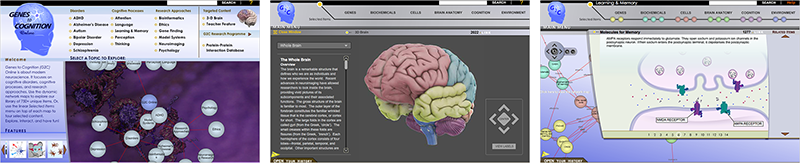
Flash animation technology is no longer supported by web browsers. Several DNALC websites were built using Flash and we have installed the open-source Flash emulator, Ruffle, on some of them. Unfortunately, due to the structure of the site, Genes to Cognition Online cannot be supported using Ruffle and it has been retired. Much of the animation and video content is available in the Resources section of this site. If there is an item you can no longer find, please email dnalc-it@cshl.edu.
In 2005, we began development of Genes to Cognition (G2C) Online, a site on current research on the molecular basis of human thinking and disorders of thinking. The project is revolutionary because it was built in parallel with a major international research program—its namesake G2C at the Wellcome Trust Sanger Institute—and because it employs a nonlinear, network structure designed to provide a user-driven learning experience.
Genes to Cognition (G2C) Online examines thinking and disorders of thinking across six levels of analysis: Genes, Biochemicals, Cells, Brain, Cognition (Behavior), and Environment. If site visitors are interested in autism, they will be able to view the disorder through a number of lenses that represent a continuum of approaches to science. So, autism is seen not only as a disorder of behavior, but a disorder of the brain, of neural circuits that make up the brain, of cells that make up these circuits, of proteins that signal within these cells, and, finally, of genes that encode these proteins.
We have incorporated two ways of exploring the site: users can interact with the dynamic networks maps to explore more than 750 items of unique content, or choose to follow the Selected Items 'Subway Line' for a tour of highlighted content. G2C Online features a variety of content: 2- and 3-D animations, demonstrations, interactive maps, text articles, and video interviews. Interactive tools, including the G2C 3-D Brain, Fly School, Model Center, and Chromosome Map of Disorders and Processes, engage visitors. History, search, and glossary features assist with exploration.
G2C Online was produced by the DNA Learning Center of Cold Spring Harbor Laboratory. The project was supported by the Dana Foundation and the William and Flora Hewlett Foundation.