


Concept 33: Genes can be turned on and off.
Organisms can regulate gene expression.
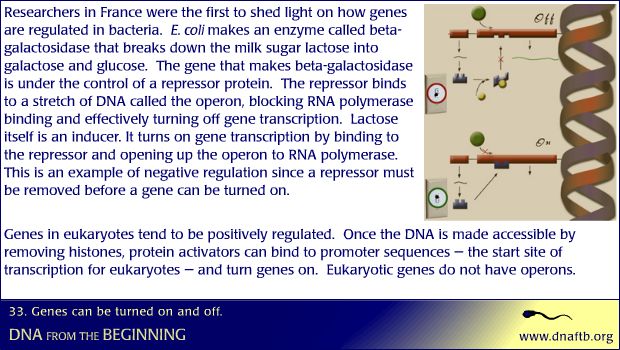
As researchers untangled the genetic code and the structure of genes in the 1950s and 60s, they began to see genes as a collection of plans, one plan for each protein. But genes do not produce their proteins all the time, suggesting that organisms can regulate gene expression. French researchers first shed light on gene regulation using bacteria. When lactose is available, E. coli turn on an entire suite of genes to metabolize the sugar. Researchers tracked the events lactose initiates and found that lactose removes an inhibitor from the DNA. Removing the inhibitor turns on gene production. The gene that produces the inhibitor is a regulatory gene. Its discovery altered perceptions of development in higher organisms. Cells not only have genetic plans for structural proteins within their DNA, they also have a genetic regulatory program for expressing those plans.
gene expression, regulatory gene, french researchers, regulatory program, gene regulation, e coli, genes, organisms, proteins, bacteria, dna, cells
- ID: 16687
- Source: DNALC.DNAFTB
Related Content


15276. Genes control the structure of proteins, François Jacob
François Jacob talks about Genes control the structure of proteins

16704. Concept 34: Genes can be moved between species.
Recombinant DNA technology has made it possible to test gene function in bacteria or cell cultures rather than animal models.

15684. Jacob's lac operon drawing
Small image of François Jacob's lac operon drawing.

16759. Concept 37: Master genes control basic body plans.
Fruit fly mutaitons provided keys to understanding the molecular basis of large-scale developmental plans.

16705. Animation 34: Genes can be moved between species.
Stanley Cohen and Herbert Boyer transform bacteria with a recombinant plasmid, and Doug Hanahan studies induced transformation.

15486. The human genome: genes and non-coding DNA, 3D animation with basic narration
The human genome: genes and non-coding DNA, 3D animation with basic narration.

548. Model Center
Model organisms share with humans many key biochemical and physiological functions that have been conserved (maintained) by evolution.

16755. Biography 36: Thomas Dean Sargent (1953- )
Tom Sargent did some of the first differential gene expression studies using cDNA subtraction.

16735. Concept 36: Different genes are active in different kinds of cells.
Cells differentiate because specific enzymes turn genes on and off in various cell types.