


Model organisms (yeast, bacteria, mouse, fruit fly)
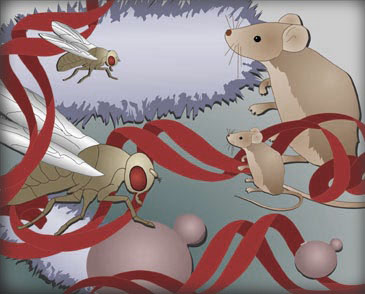
Model organisms such as yeast, bacteria, the mouse and the fruit fly are used by researchers to study biological systems. The genomes of these organisms have been mapped and sequenced.
human genome project,model organisms,fruit fly,project model,genomes,biological systems,yeast,bacteria,fly
- ID: 15566
- Source: DNALC.DNAi
Related Content

15628. Model organisms
Some of the plants, animals, and microorganisms used by researchers as "model" biological systems.

555. Model Organisms
A human is a complicated organism, and it is considered unethical to do many kinds of experiments on human subjects. For these reasons, biologists often use simpler “model” organisms that are easy to keep and manipulate in the laboratory.

1433. What are Model Systems? (1)
Doctor Josh Dubnau explains that model systems are particular species of animals that substitute for humans or other animals. For genetic and historic reasons, the fruit fly is a commonly used model.

548. Model Center
Model organisms share with humans many key biochemical and physiological functions that have been conserved (maintained) by evolution.

1719. Fruit fly (Drosophila melanogaster)
The fruit fly is easy to maintain, has large numbers of offspring, and grows quickly. The fruit fly shares with humans a number of so-called “master,” or homeotic, genes.

1063. Drosophila as a Model System
Professor David Van Vactor discusses the properties that make the fruit fly (drosophila) a powerful model system.

1073. Drosophila as a Memory Model
Professor Ron Davis discusses the attributes that make the fruit fly a good model for studying memory in humans.

1714. Yeast (Saccharomyces cerevisiae)
Yeast was the first eukaryote organism to have its entire genome sequenced. It has remained at the forefront of genetics research because it is quick and easy to grow.

1361. Model Organisms (Lesson)
Students work through a series of experiments that investigate the use of model organisms in the search for a better understanding of the genes that influence memory formation.

15909. Storing DNA
To store DNA, you need unusual storage containers. Organisms such as bacteria and viruses were the Human Genome Project's unconventional libraries and duplicating systems.